Last updated: November 15, 2026
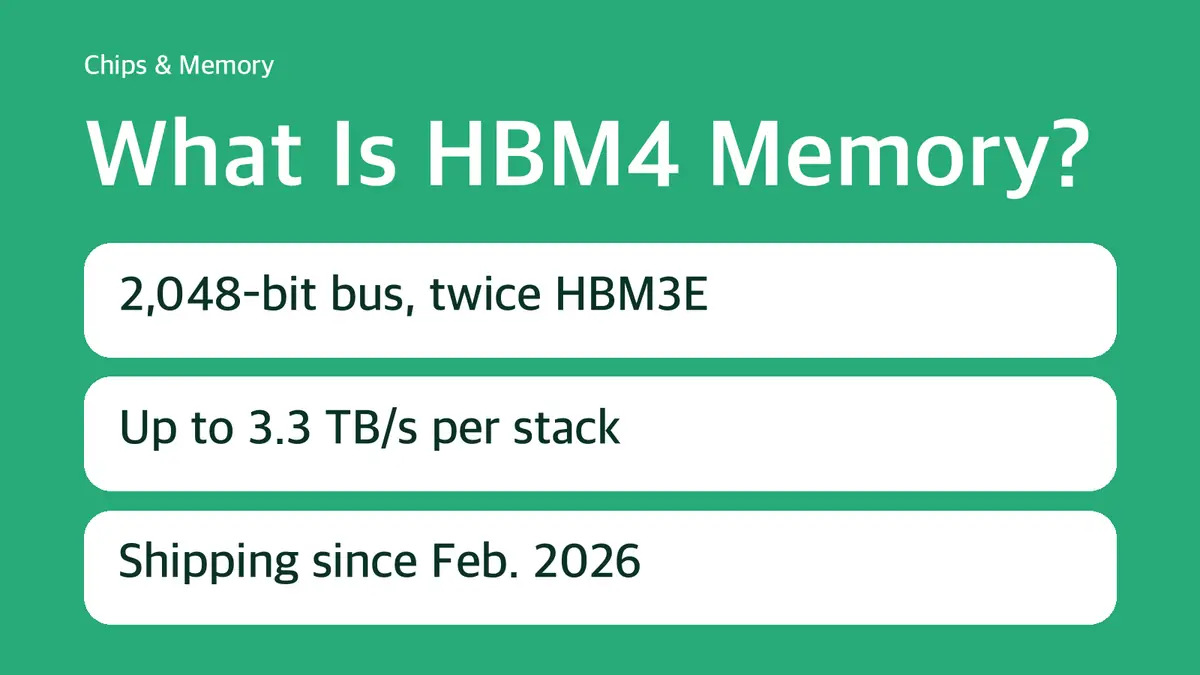
HBM4 in one table
| HBM4 (JEDEC standard) | What shipping HBM4 does | |
|---|---|---|
| Interface width | 2,048 bits per stack (HBM3E: 1,024) | Same |
| Speed per pin | Up to 8 Gb/s | 10 to 11.7 Gb/s, depending on the maker |
| Bandwidth per stack | About 2 TB/s | Over 2.8 TB/s (Micron), up to 3.3 TB/s (Samsung) |
| Independent channels | 32 per stack (HBM3: 16) | Same |
| Stack height | 4, 8, 12 or 16 chips | 12-high in volume, 16-high sampling |
| Capacity per stack | Up to 64GB | 24GB to 36GB now, 48GB next |
| Who it's for | AI accelerators and supercomputers | Nvidia's Vera Rubin platform and other AI chips |
JEDEC, the group that writes memory standards, published HBM4 as JESD270-4 in April 2025. Samsung, SK hynix and Micron all helped write it, and all three now make it.
How HBM is different from the RAM in your PC
Regular RAM, like the DDR5 sticks in a desktop, sits a few inches from the processor and talks to it over a fairly narrow path. That works for everyday computing.
AI chips have a different problem. They can do math faster than memory can feed them data, so the processor sits idle waiting. HBM solves that in two ways:
- It stacks DRAM chips on top of each other, connected by tiny vertical wires drilled through the silicon. A 12-high stack is twelve memory chips in one small tower.
- It sits right beside the processor on the same package, joined by thousands of connections. A wide path moving at moderate speed beats a narrow path moving very fast.
Think of it as replacing a two-lane highway with a 2,048-lane road that runs a short distance. Each lane is slower than a gaming card's memory lane, but there are so many that the total traffic is far higher.
What changed from HBM3E to HBM4
1. The bus doubled. HBM3E used 1,024 data connections per stack. HBM4 uses 2,048. That single change is where most of the bandwidth gain comes from.
2. Twice as many channels. The standard splits each stack into 32 independent channels instead of 16, so the processor can read and write different parts of memory at the same time.
3. A smarter base chip. The bottom layer of the stack, called the base die, now handles more logic work. Samsung builds its base die on its own 4nm logic process, the same kind of process used for processors.
4. Bigger stacks. The standard allows up to 16 chips per stack and up to 64GB. Shipping parts are 36GB today, with 48GB versions sampling.
5. Better efficiency. Samsung and SK hynix each claim about 40% better power efficiency than their HBM3E. Micron claims 20% better.
HBM4 controllers can also work with HBM3, so chip designers can support both with one design.
Samsung vs. SK hynix vs. Micron HBM4
| Maker | Status | Speed per pin | Bandwidth per stack | Capacity |
|---|---|---|---|---|
| Samsung | Mass production and first commercial shipments, Feb. 12, 2026 | 11.7 Gb/s, up to 13 Gb/s | Up to 3.3 TB/s (2.7x its HBM3E) | 24–36GB (12-high); 48GB 16-high planned |
| SK hynix | Development finished Sept. 2025; shipments "began in earnest" in Q3 2026 | 10 Gb/s | Not stated in its announcement | 12-high |
| Micron | High-volume production, shipping since Q1 2026 | Over 11 Gb/s | Over 2.8 TB/s | 36GB (12-high); 48GB 16-high samples |
All three beat the standard's 8 Gb/s by a wide margin. Samsung's 11.7 Gb/s is about 46% above the standard, by Samsung's own count.
The makers took different routes. Samsung jumped to its newest DRAM process (1c) and a 4nm base die. SK hynix stuck with the 1b process and stacking method it already used for HBM3E to lower production risk. Micron says its HBM4 was designed for Nvidia's Vera Rubin.
Where HBM4 stands now
The latest numbers come from the two Korean makers' third-quarter results, released at the end of October.
SK hynix (Oct. 28): HBM4 shipments began in earnest in Q3. The company expects HBM4 to pass HBM3E in both shipments and revenue in Q4 2026, which would make it SK hynix's main HBM product. It is pushing its new M15X fab to full capacity by year-end to make more HBM4.
Samsung (Oct. 29): Samsung said it "significantly scaled up" HBM4 sales in Q3. Back in February, it said it expected its HBM sales to more than triple in 2026 compared with 2025.
Next up is HBM4E. Samsung said HBM4E sampling would begin in the second half of 2026, with custom HBM samples reaching customers in 2027.
Why HBM4 matters if you never buy one
You won't find HBM4 in a gaming PC. Even Nvidia's top consumer card, the GeForce RTX 5090, uses 32GB of GDDR7 on a 512-bit bus, not HBM. HBM4 is sold to chip companies and ends up in data center accelerators.
It still reaches your wallet, because HBM and regular RAM come from the same DRAM wafers and the same factories.
HBM uses a lot more wafer per gigabyte. Micron CEO Sanjay Mehrotra said in June 2025 that HBM3E's "trade ratio" is about 3, meaning it takes roughly three times the wafer capacity of standard DRAM for the same amount of memory. He said HBM4's ratio is greater than 3 because the chips are larger, and that the ratio heads toward 4 with HBM4E. He added that this "absolutely" puts pressure on non-HBM supply.
Two more signals from the Korean makers point the same way:
- Makers are moving capacity to AI. Samsung said its memory business ran "amid capacity constraints" in Q3 and that strong server demand led to higher market prices across all applications. It expects AI demand in 2027 to far exceed supply.
- The shortage has a long runway. SK hynix expects demand to outpace supply through 2030. It has long-term contracts covering more than 50% of its 2027–2028 capacity, with 14 major customers.
Put simply, every HBM4 stack built for an AI server is wafer that didn't become DDR5 for a laptop or GDDR7 for a graphics card. That's a big part of why RAM prices, SSD prices and GPU prices kept climbing through 2026.
FAQ
Is HBM4 out yet? Yes. Samsung began mass production and commercial shipments in February 2026, Micron began volume shipments in Q1 2026, and SK hynix ramped up in Q3 2026.
HBM4 vs. GDDR7: which is faster? Per pin, GDDR7 is faster. Per chip package, HBM4 moves far more data because its bus is 2,048 bits wide. That's why AI accelerators use HBM and gaming cards use GDDR7, which is cheaper and easier to build into a graphics card.
What does HBM4 stand for? High Bandwidth Memory 4. SK hynix and Korean media call it the sixth generation of HBM, because HBM, HBM2, HBM2E, HBM3 and HBM3E came before it.
HBM4 vs. HBM4E? HBM4E is the enhanced follow-up. Samsung planned HBM4E sampling for the second half of 2026, and Micron says HBM4E's trade ratio will be even higher than HBM4's.
Sources
- Samsung: Samsung Ships Industry-First Commercial HBM4 (Feb. 12, 2026)
- Samsung: Third Quarter 2026 Results (Oct. 29, 2026)
- SK hynix: 3Q26 Financial Results (Oct. 28, 2026)
- Korea Times: SK hynix completes HBM4 development (Sept. 12, 2025)
- Micron: HBM4 in high-volume production for NVIDIA Vera Rubin (March 16, 2026)
- JEDEC JESD270-4 HBM4 standard release (April 2025, via StorageNewsletter)
- Micron Q3 FY2025 earnings call transcript (June 25, 2025, The Motley Fool)
- NVIDIA: GeForce RTX 5090 specs
Figures are as of November 15, 2026. Speeds and capacities are each maker's own published numbers.
Related guides
 Will RAM Prices Go Down? Not in 2027, Memory Makers SignalRAM prices are still rising in late 2026, only more slowly. Supply for PCs is set to shrink in 2027 as chipmakers…
 GPU Prices Going Up? Yes, 35% in 3 Months, and 2027 Looks TightGraphics card prices are still climbing in late 2026. Memory costs, partner price hikes and a missing RTX 5090 are…
 DDR5 Price Now: 16GB Sticks Near $242 Wholesale, Still RisingDDR5 is still getting more expensive. Here are the latest wholesale numbers from TrendForce, why memory makers keep…