Last updated: November 3, 2026
DDR5 prices right now
These are wholesale prices between memory makers, module makers and distributors, tracked by TrendForce's DRAMeXchange. Retail prices in stores usually follow them with a delay.
| Item | Average price | Range | Date |
|---|---|---|---|
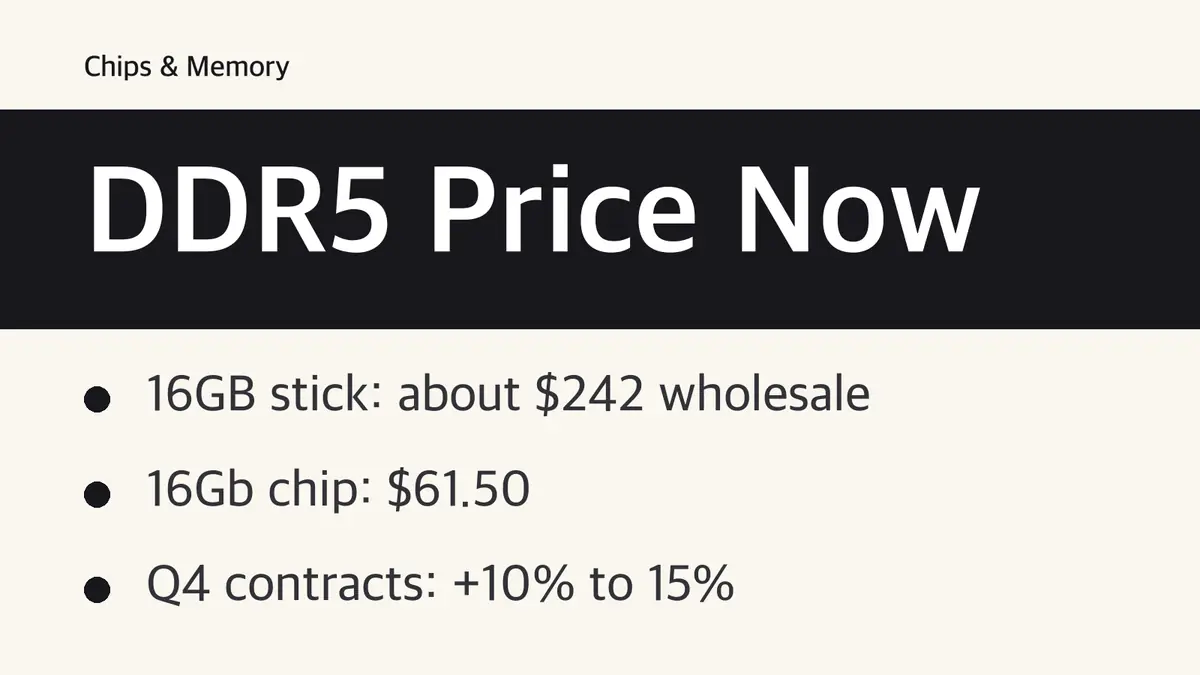
| DDR5 16Gb (2Gx8) 4800/5600 chip, spot | $61.50 | $46.80–$73.50 | Nov 3, 2026 |
| DDR5 16Gb chip, eTT (lower grade), spot | $30.00 | $29.20–$31.00 | Nov 3, 2026 |
| DDR5 UDIMM 16GB 4800/5600 (desktop stick), spot | $241.67 (+0.70%) | $220–$275 | Week to Oct 26, 2026 |
| DDR5 RDIMM 32GB 4800/5600 (server stick), spot | $2,165 | $2,100–$2,370 | Week to Oct 26, 2026 |
| DDR5 8GB SO-DIMM (laptop stick), contract | $133 | $118–$141 | Second half of September 2026 |
The wide range on the chip price, a low of $46.80 against a high of $73.50 on the same day, suggests a tight market where sellers quote very different prices.
For comparison, a DDR4 16GB 3200 desktop stick averaged about $164 in the same week, so DDR4 is cheaper per stick but is also no longer a bargain.
Q4 2026 forecast: up another 10–15%
TrendForce's quarterly outlook, published September 30, 2026:
| Memory | Q4 2026 contract price change vs. Q3 |
|---|---|
| Conventional DRAM | +10% to 15% |
| NAND Flash | +15% to 20% |
TrendForce says the increases are slowing, not reversing. Memory makers keep moving their newest production lines to high-performance server products, which keeps the rest of the market undersupplied. For PC memory, TrendForce reports that laptop makers keep buying aggressively because they expect supply to stay tight in 2027, and that PC DRAM supply could shrink in 2027 as more capacity shifts to servers.
Why DDR5 is not getting cheaper: what SK hynix reported
SK hynix, the South Korean memory maker, reported its third quarter on October 28, 2026. Its results show where DRAM supply is going:
| SK hynix Q3 2026 | Figure |
|---|---|
| Revenue | 104.6 trillion won, its first quarter above 100 trillion won |
| Operating profit | 83.3 trillion won, an 80% operating margin |
| Revenue change vs. Q2 | +32% |
| What drove DRAM sales | A "significant increase" in server DDR5, plus HBM4 shipments |
Three points from the release explain the price picture for ordinary buyers:
- Server first. SK hynix plans to expand DDR5 and LPDDR5 SOCAMM sales "for AI servers" and to push its newest 1c process. That is where the profit is.
- Capacity is already sold. Long-term agreements with 14 major customers cover more than 50% of its total production capacity for 2027 and 2028.
- No quick fix. The company expects demand to exceed supply through 2030, because leading-edge processes are hard and new fabs take years to build. That is the company's own outlook, not a neutral forecast, but it matches TrendForce's view that 2027 supply stays tight.
What this means if you are buying RAM or a PC
- Do not wait for a crash. Neither the wholesale data nor SK hynix's outlook points to falling DDR5 prices in the next few months. If you need memory for a build now, buying now avoids the Q4 contract increases reaching store shelves.
- Buy the capacity you need, once. With prices still climbing, adding a second kit later is likely to cost more than buying the full amount up front.
- Expect pricier laptops and prebuilt PCs. TrendForce reports that higher component costs are already showing up in notebook inventories, and PC brands are cutting SSD capacity in mainstream models to save cost.
- DDR4 is not a cheap escape. DDR4 contract prices were still rising in the latest TrendForce data, with DDR4 16GB laptop sticks up 1.85% and DDR4 chips up 4%.
Sources
- TrendForce: DRAM spot price
- TrendForce: DRAM module spot price
- TrendForce: AI server demand sustains memory contract price increases in 4Q26 (Sept. 30, 2026)
- SK hynix Newsroom: SK hynix announces 3Q26 financial results (Oct. 28, 2026)
Prices are wholesale averages as of the dates shown and change daily. Store prices vary by brand, speed and retailer.