Last updated: November 16, 2026
How much US phone prices went up in 2026
These are official US starting prices before and after this year's increases.
| Phone | Before | Now | Change | When |
|---|---|---|---|---|
| iPhone 17e | $599 | $699 | +$100 | Sept. 9, 2026 |
| iPhone 17 | $799 | $899 | +$100 | Sept. 9, 2026 |
| iPhone Air | $999 | $1,099 | +$100 | Sept. 9, 2026 |
| iPhone 16 | $699 | $799 | +$100 | Sept. 9, 2026 |
| iPhone 18 Pro (vs. iPhone 17 Pro) | $1,099 | $1,199 | +$100 | New model, Sept. 2026 |
| Galaxy S26, 256GB | $899.99 | $999.99 | +$100 | Oct. 1, 2026 |
| Galaxy S26 Ultra, 256GB | $1,299.99 | $1,399.99 | +$100 | Oct. 1, 2026 |
| Galaxy S26 Ultra, 1TB | $1,799.99 | $1,999.99 | +$200 | Oct. 1, 2026 |
| Galaxy S26 FE | $699.99 | $699.99 | No change | — |
Two things stand out. First, Apple and Samsung raised prices on phones already on sale, not just new models. Phones usually get cheaper as they age. Second, Samsung's increase came about seven months after launch, which is unusual for its flagship line.
Google took the same route. In July, a Google devices executive told 9to5Google that the entire Pixel family would get price "adjustments" to match supply, including the Pixel 11 series and phones already on the market.
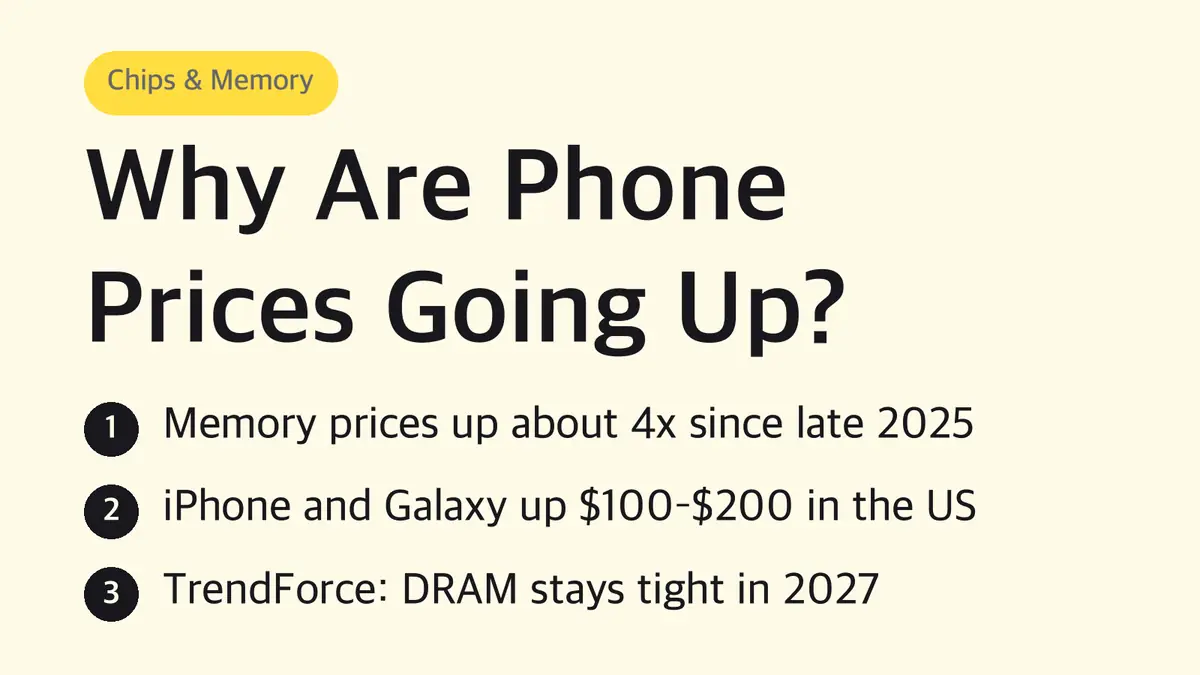
The main reason: memory chips got very expensive
Every phone has two kinds of memory. RAM (DRAM) is the working memory apps run in. Storage (NAND flash) holds your photos and apps. Both have soared.
| Measure | Then | Now | Source |
|---|---|---|---|
| Memory prices overall | Late 2025 | About 4x higher | Counterpoint Research, Sept. 2026 |
| Price of 1GB of RAM | $2.80 in 2025 | $12 in 2026 | Morgan Stanley data, cited by Google |
| Memory's share of an $800 phone's build cost | About 14% (Q1 2025) | About 40% | Counterpoint, via Financial News (Korea) |
When memory goes from a small line item to roughly two-fifths of the bill of materials, phone makers can't absorb it. Apple CEO Tim Cook told The Wall Street Journal in June that Apple could no longer absorb higher memory and storage costs, according to MacRumors. He compared the shortage to a hundred-year flood.
Why memory got so expensive
AI data centers are buying memory as fast as chipmakers can make it. Server chips, especially stacked high-bandwidth memory that sits next to AI processors, earn memory makers far more than phone chips do. So Samsung, SK hynix and Micron keep moving production lines toward servers.
TrendForce, a Taiwan-based market tracker, said on September 30 that mobile DRAM supply for phones "remains tight" because suppliers keep shifting capacity to servers. Phone makers are getting a smaller share of a market that is already short.
The Korean view: Samsung's phone unit is paying for its chip boom
Korean media have tracked this squeeze closely, because Samsung sits on both sides of it. The Korea Herald reported on October 2 that Samsung's semiconductor division earned 89.2 trillion won in operating profit in the second quarter as memory earnings surged on AI-server demand. In the same quarter, its mobile and networks business posted a 700 billion won operating loss, down from a 2.8 trillion won profit three months earlier. Samsung cited higher component costs across the industry.
In other words, the company selling you the Galaxy is also selling the expensive memory, and its own phone business still lost money.
Are phone prices going up everywhere?
Yes, but the US has been hit less than most places so far. Counterpoint's Global Smartphone Price Increase Tracker, published September 3, found:
| Market | Average price rise for phones on sale, 2026 |
|---|---|
| India | 21% |
| Asia Pacific | 19% |
| Middle East and Africa | 18% |
| Latin America | 16% |
| Global average | 15% |
| China | 10% |
| Europe | 7% |
| United States | 5% |
Counterpoint also found that more than 40% of phone models had a price increase in 2026, which it called a first for the industry. New launches cost about 25% more than the models they replaced.
The US number is lower for two reasons, per Counterpoint. Many Americans buy on postpaid carrier plans, which spread the cost over monthly payments. And US increases have landed mostly on new launches rather than older phones.
Cheaper phones are taking the biggest hit
Memory is a bigger slice of a budget phone's cost, so low-end models rise the most. Phone makers are also quietly cutting specs to hold prices:
- Less storage or RAM. Counterpoint lists lower storage capacities and reduced camera setups among the common cost cuts. Leaks reported by 9to5Google pointed to the entry Pixel 11 Pro dropping from 16GB of RAM to 12GB.
- Reused memory chips. TrendForce said on November 6 that more budget phones use "reballed" memory, meaning chips recovered from used devices and refitted. It expects that share to reach 3–4% of smartphones in 2026 and 7–9% in 2027, mostly in low-cost 4G models. TrendForce warns these parts can be less consistent in quality and may shorten device life.
Will phone prices keep going up in 2027?
Most signals say yes, at least for new models. These are forecasts, not guarantees.
| Forecast | What it says | Source and date |
|---|---|---|
| DRAM contract prices, Q4 2026 | Up 10–15% from Q3 | TrendForce, Sept. 30, 2026 |
| NAND flash contract prices, Q4 2026 | Up 15–20% from Q3 | TrendForce, Sept. 30, 2026 |
| DRAM prices, early 2027 | Increases expected to gain momentum in Q1 2027 | TrendForce, Nov. 6, 2026 |
| DRAM supply in 2027 | Gap between supply and demand widens; new factories add meaningful output only in 2028 | TrendForce, July 30, 2026 |
| NAND flash in 2027 | Supply loosens in the second half of 2027 | TrendForce, July 30, 2026 |
| New phone prices | "Expected to keep rising over the coming quarters" | Counterpoint, Sept. 3, 2026 |
The storage side may ease first, since NAND supply is set to grow in late 2027. RAM is the bigger problem, and TrendForce does not see real relief before new factories ramp up.
What's rumored for the Galaxy S27
Samsung's next flagship, expected in early 2027, may cost more again. Korean leaker Lanzuk said Samsung is preparing higher starting prices than it first planned, by up to about $100, with bigger jumps on higher-storage models, the Korea Herald reported on October 2. Samsung has not confirmed this, and the claim has not been independently verified.
Should you buy a phone now or wait?
Waiting is unlikely to save money on a new phone in the next year. Here is how the choice breaks down.
| Your situation | What makes sense |
|---|---|
| Your phone works fine | Keep it. 2027 models are expected to cost more, not less. A new battery costs far less than a new phone. |
| You need a phone soon | Buy now rather than wait for 2027 models, and use trade-in or carrier credits to cut the upfront cost. |
| You want a Galaxy flagship | Look at the Galaxy S26 FE. It skipped the October increase, so the 256GB FE is now $200 below the 256GB S26. |
| You're picking storage | Buy the capacity you need now. Each storage step costs more than it used to, and the 1TB S26 Ultra rose the most. |
| You're on a tight budget | Consider a refurbished or last-generation phone. Counterpoint says more buyers are doing this, and trade-in and carrier credits soften the price. |
One caution on budget phones: very cheap models are where reused memory chips are spreading. Buying from a known brand with a real warranty matters more than usual right now.
Will phone prices ever come back down?
Not soon. Memory makers are building new factories, but TrendForce expects them to add meaningful output only in 2028. Even then, prices that went up on store shelves rarely fall back to where they were. The more realistic hope is that increases slow down once memory supply catches up, with discounts and trade-in deals doing most of the work in the meantime.
Sources
- Counterpoint Research: Global Existing Smartphone Prices Climb About 15% in 2026 (Sept. 3, 2026)
- TrendForce: AI Server Demand Sustains Memory Contract Price Increases in 4Q26 (Sept. 30, 2026)
- TrendForce: Diverging Memory Market Outlook in 2027 (July 30, 2026)
- TrendForce: Reballed Memory Adoption in Smartphones (Nov. 6, 2026)
- Apple Newsroom: Apple debuts iPhone 18 Pro and iPhone 18 Pro Max
- Apple Newsroom: Apple unveils iPhone 17 Pro and iPhone 17 Pro Max
- MacRumors: Apple Raises Prices of iPhone 16, iPhone 17, iPhone Air, and iPhone 17e
- TechRepublic: Samsung Raises Galaxy S26 Prices in US by Up to $200
- 9to5Google: Google confirms Pixel 11 price increase
- The Korea Herald: Galaxy S27 prices could rise more than planned
- Financial News (Korea): Galaxy S27 Ultra price may rise
Related guides
 Will RAM Prices Go Down? Not in 2027, Memory Makers SignalRAM prices are still rising in late 2026, only more slowly. Supply for PCs is set to shrink in 2027 as chipmakers…
 Galaxy S26 FE Price: $699.99 for 128GB, $799.99 for 256GBSamsung's Galaxy S26 FE starts at $699.99 in the US, $50 more than last year's S25 FE. The main upgrade is the…
 iPhone Battery Replacement Cost: $69 to $129 at Apple by ModelApple's out-of-warranty battery service costs $69 for older iPhones, $89 to $99 for most recent ones and $119 to…