Last updated: November 17, 2026
What you need
| Requirement | What Samsung lists |
|---|---|
| Earbuds | Galaxy Buds3 Pro or Galaxy Buds4 Pro ("only") |
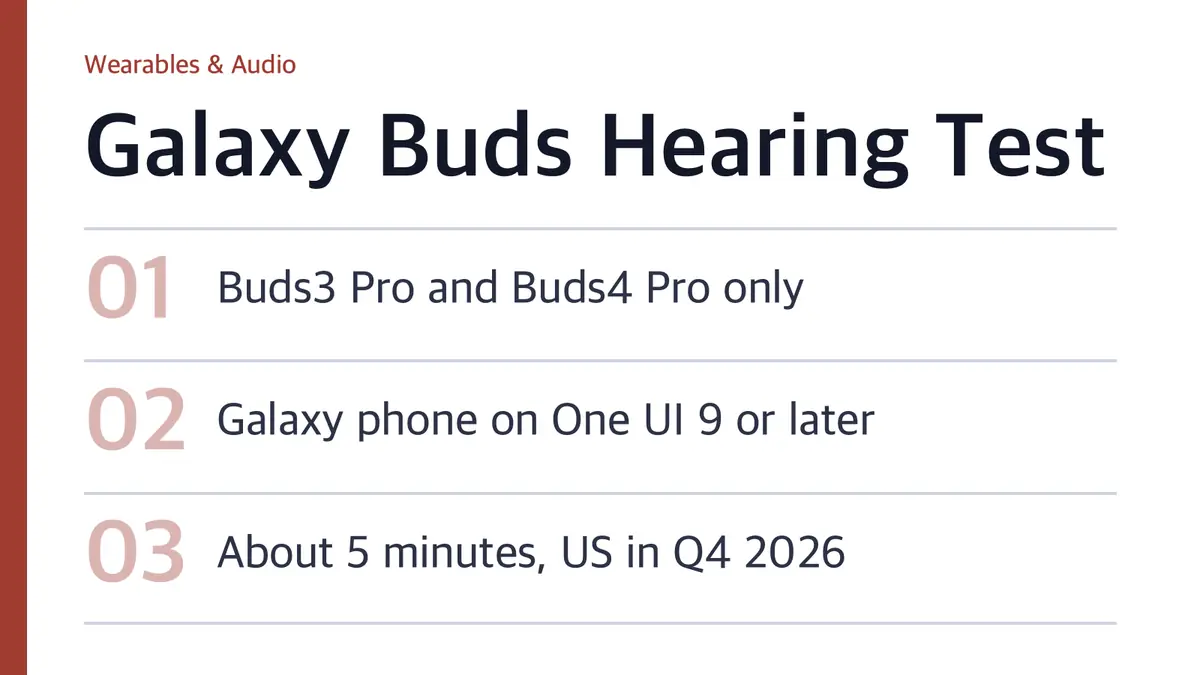
| Phone | A compatible Galaxy device with One UI 9 or later for full support |
| Extra app | None. The test lives in the Galaxy Buds menu in Settings |
| Where | US and "select approved markets" |
| When | Q4 2026 (October to December) |
| Results | Shown after the test and saved to the Samsung Health app |
Samsung also notes that availability may vary by market, model or paired device. So two people with the same earbuds can see the feature on different days.
Which Galaxy Buds get the hearing test
Only the Buds3 Pro and the Buds4 Pro. Samsung's footnote says "Galaxy Buds3 Pro and Galaxy Buds4 Pro only," and the FDA-cleared feature names no other model.
That leaves out:
- The regular Galaxy Buds 4 and Galaxy Buds3
- Galaxy Buds 2 Pro, Buds 2, Buds FE and older Buds
- Any Galaxy Buds paired with an iPhone or a non-Samsung Android phone, because full support needs a Galaxy device on One UI 9
If you searched for a "Galaxy Buds 2 Pro hearing test," the answer is no. Samsung has not said the feature will come to other models.
The Pro models also seal your ear with silicone tips, which the open-fit Buds 4 does not. If you are choosing between the two current models, the Hearing Test is one of the Pro-only extras.
How the test works
Samsung describes the test as a self-administered check that you start yourself:
- Make sure your Galaxy phone runs One UI 9 or later.
- Connect your Buds3 Pro or Buds4 Pro and install the latest earbud software when the update reaches you.
- Open Settings on the phone, then the Galaxy Buds menu.
- Choose Hearing Test and follow the prompts. Each ear is tested on its own.
- When you finish, you get an audiogram, a chart of the quietest tones you can hear at each pitch.
The method is pure-tone audiometry, the same basic method used in a standard hearing exam. The earbuds play single tones at different frequencies and find the softest level you can hear in each ear. Samsung says the whole test takes about five minutes.
What the results mean
Samsung sorts your result into normal or one of four stages of hearing loss:
- Normal
- Mild hearing loss
- Moderate hearing loss
- Severe hearing loss
- Profound hearing loss
Your two ears can land in different stages, since each one is tested separately. Results, along with noise exposure levels, show up in the Samsung Health app, so you can compare later tests over time.
Samsung says the test gives "medical-grade results" with accuracy "comparable to a professional audiologist's evaluation." That is Samsung's claim. The same announcement says the feature is not a substitute for professional diagnosis or treatment by a qualified clinician.
Hearing Test vs. Hearing Aid
These are two separate features that work together:
| Hearing Test | Hearing Aid | |
|---|---|---|
| What it does | Measures each ear and builds an audiogram | Boosts the sounds you have trouble hearing |
| Regulatory status | Registered as Software as a Medical Device (SaMD) | FDA-cleared as an over-the-counter (OTC) hearing aid |
| Who it is for | Anyone with the supported earbuds | Adults (18+) who believe their hearing loss is mild to moderate |
| Extra features | Results in Samsung Health | Noise elimination and beamforming (focus on sound in front of you) |
The Hearing Aid feature uses your test result. It applies NAL-NL2, a fitting formula developed by Australia's National Acoustic Laboratories and widely used for prescription hearing aids. Samsung says it boosts high frequencies, whispers and distant voices to match your profile, with no prescription or clinic visit.
If your test shows severe or profound loss, the OTC Hearing Aid feature is not meant for you. That level of loss calls for a hearing professional.
When the test is not enough
The Hearing Test checks how well you hear tones. It does not look for the cause of hearing loss.
If you lose hearing suddenly, in one ear or both, all at once or over a few days, do not wait for a test result. The US National Institute on Deafness and Other Communication Disorders (NIDCD) says to treat sudden deafness as a medical emergency and see a doctor immediately, because delaying treatment can make it less effective. Warning signs NIDCD lists include a feeling of ear fullness, dizziness or ringing in the ears.
How it compares with the AirPods Pro hearing test
Apple offers the same pair of features on AirPods Pro. Here is how the requirements line up in the US:
| Galaxy Buds | AirPods Pro | |
|---|---|---|
| Earbuds | Buds3 Pro, Buds4 Pro | AirPods Pro 2, AirPods Pro 3 |
| Phone | Galaxy phone, One UI 9 or later | iPhone or iPad, iOS 18 or iPadOS 18 or later |
| Hearing aid age | 18 and older | 18 and older |
| Hearing aid range | Perceived mild to moderate loss | Perceived mild to moderate loss |
| US status | Coming in Q4 2026 | Available |
Each one is locked to its own phone brand. Galaxy Buds on an iPhone will not get Samsung's test, and AirPods on a Galaxy phone will not get Apple's.
Common questions
Can Galaxy Buds be used as a hearing aid?
Yes, but only the Buds3 Pro and Buds4 Pro with the FDA-cleared Hearing Aid feature, and only for adults age 18 or over who think their loss is mild to moderate. You run the Hearing Test first, and the Hearing Aid feature tunes itself to that result.
Is the Galaxy Buds hearing test available now?
Samsung's US schedule is Q4 2026 for both the Hearing Test and the Hearing Aid. When the update reaches your phone and earbuds, the Hearing Test appears in the Galaxy Buds menu in Settings.
Does the hearing test replace a visit to an audiologist?
No. Samsung states the feature is not a substitute for professional diagnosis or treatment by a qualified clinician.
Sources
- Samsung US Newsroom: Samsung's Hearing Aid Feature on Galaxy Buds Cleared by FDA (Aug. 11, 2026)
- Samsung Global Newsroom: Samsung's Hearing Aid Feature on Galaxy Buds Cleared by FDA
- Apple: AirPods Pro Hearing Health Feature Availability
- NIDCD: Sudden Sensorineural Hearing Loss
This guide is general information, not medical advice. The Hearing Test is not a diagnosis, so see a hearing professional or doctor about any hearing concern. Feature availability varies by market and device.
Related guides
 Galaxy Buds 4 vs Buds 4 Pro: $70 Buys a Sealed Fit and IP57The Galaxy Buds 4 and Buds 4 Pro look almost the same, but the $70 gap comes down to fit, sound hardware, water…
 Galaxy Ring Sleep Apnea: Now Available, Needs 2 Nights in 10 DaysSamsung's upgraded Sleep Apnea feature reached Galaxy Ring and Galaxy Watch9 on November 3, 2026. Here is how the…