Last updated: November 17, 2026
DRAM market share in Q3 2026
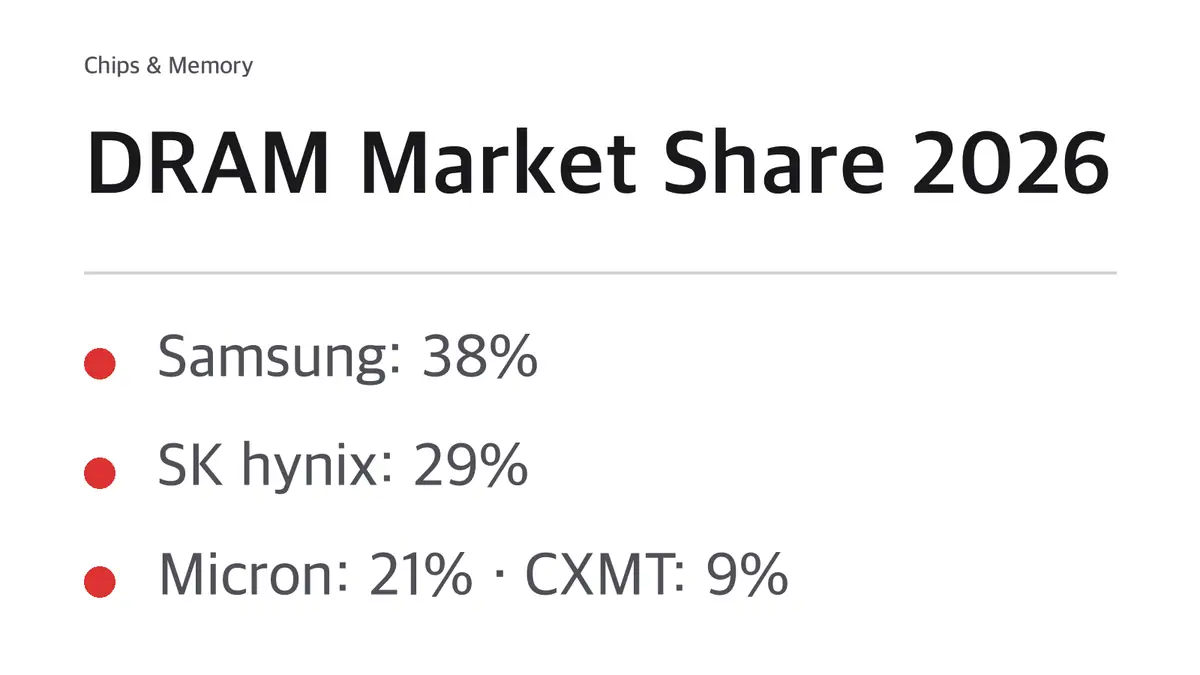
Counterpoint's Q3 2026 Global Memory Tracker measures share by revenue. Here is where the companies stand.
| Rank | Company | Q3 2026 share | Change from Q2 2026 |
|---|---|---|---|
| 1 | Samsung (South Korea) | 38% | About flat |
| 2 | SK hynix (South Korea) | 29% | Up 3 points |
| 3 | Micron (U.S.) | 21% | Down |
| 4 | CXMT (China) | 9% | Down from 10% |
Source: Counterpoint Research Q3 2026 Global Memory Tracker, as reported by Counterpoint and SBS Biz on November 5, 2026. Revenue basis.
Three things stand out:
- The market is huge now. Counterpoint puts Q3 DRAM revenue at nearly $200 billion, up 369% from a year earlier.
- Prices did the work, not volume. Bit shipments rose only about 4% in the quarter. The average selling price reached $1.9 per gigabit.
- SK hynix bounced back. Its revenue grew more than 40% from Q2, which won back some of the share it lost in the first half.
Quarter by quarter: two trackers side by side
Market research firms do not agree to the decimal point. They estimate revenue from company reports and their own price data, and they revise past quarters. Compare numbers within one tracker, not across trackers.
Counterpoint Research (revenue, rounded)
| Quarter | Samsung | SK hynix | Micron | CXMT |
|---|---|---|---|---|
| Q3 2025 | 33% | 33% | 26% | 5% |
| Q4 2025 | 36% | 32% | 22% | 8% |
| Q1 2026 | 38% | 29% | 22% | 8% |
| Q2 2026 | 38% | 25% | 24% | 10% |
| Q3 2026 | 38% | 29% | 21% | 9% |
Q3 2025 to Q2 2026 come from Counterpoint's quarterly DRAM share table (Q2 2026 edition). Q3 2026 comes from its November 5 release. Counterpoint's Q3 release describes SK hynix's gain as 3 points from Q2, so its Q2 figure has been revised slightly since the table was published.
TrendForce (revenue, with dollar amounts)
| Quarter | Samsung | SK hynix | Micron | Total DRAM revenue |
|---|---|---|---|---|
| Q3 2025 | 32.6% ($13.5B) | 33.2% ($13.75B) | 25.7% ($10.65B) | $41.4B |
| Q1 2026 | 38.5% ($37.32B) | 28.8% ($27.98B) | 22.4% ($21.75B) | $97B |
| Q2 2026 | 39.4% ($60.98B) | 24.9% ($38.59B) | 23.3% ($36.0B) | $154.73B |
TrendForce put CXMT at 9.5% in Q2 2026, up from 7.6% in Q1. TrendForce published its Q2 ranking on September 7, 2026, and its Q3 2025 ranking on November 26, 2025, so its Q3 2026 numbers are likely to land in late November.
Samsung's own filing
Samsung also reports its DRAM share in its business reports filed in Korea. Its half-year report, filed August 14, 2026, put Samsung's DRAM share for the first half of 2026 at 39.4%, up from 34.0% for 2025, the biggest gain of any product line it tracks, according to Yonhap News Agency's report on the filing. That lines up with the outside trackers: Samsung gained roughly 5 points in a year.
How the lead changed hands in one year
A year ago, SK hynix was No. 1. In Q3 2025, TrendForce ranked SK hynix first with 33.2% and Samsung second with 32.6%. Counterpoint called it a tie at 33% each.
By Q4 2025 Samsung had moved ahead, and the gap widened through 2026. The reasons, according to TrendForce and Counterpoint:
- SK hynix sells more HBM than anyone. HBM is the stacked memory that sits next to AI chips. TrendForce says HBM made up the largest share of SK hynix's bit shipments among the top three, and HBM contract prices fell in 2026 while ordinary DRAM prices jumped. So SK hynix's average price rose less than its rivals'.
- Ordinary DRAM got very expensive. Conventional DRAM contract prices rose about 93% to 98% in Q1 2026 alone, per TrendForce. Samsung, with more conventional and server DRAM in its mix, captured more of that rise. Counterpoint says DDR and LPDDR revenue grew 500% and nearly 400% from a year earlier.
- Samsung shipped HBM4 early. TrendForce credits Samsung's early move into HBM4 mass production for its strong Q2 shipment growth.
- Micron chose servers. TrendForce says Micron kept prioritizing higher-priced server DRAM while capacity was tight. That lifted its Q2 share to 23.3%, but Counterpoint shows it growing more slowly than both Korean companies in Q3.
HBM market share is a different story
The AI memory segment has its own leaderboard, and SK hynix still leads it.
| Quarter | SK hynix | Samsung | Micron |
|---|---|---|---|
| Q2 2025 | 64% | 15% | 21% |
| Q1 2026 | 58% | 21% | 21% |
| Q2 2026 | 50% | 33% | 18% |
Source: Counterpoint Research, HBM revenue share (Q2 2026 edition).
The gap is closing fast. On its October 29 earnings call, Samsung said HBM4 revenue more than tripled from Q2 to Q3 and made up about 60% of its HBM sales, and that its HBM share now matches its standing in the overall DRAM market, as Chosun Biz reported (via TrendForce). Samsung also said its planned 2027 HBM supply is effectively sold out. Counterpoint expects Samsung to take the top spot in HBM in 2027.
What about China's CXMT?
CXMT is the only company outside the big three with a meaningful share. It went from 4% in Q2 2025 to 10% in Q2 2026 on Counterpoint's numbers, then slipped to 9% in Q3.
- CXMT makes mostly conventional DRAM such as DDR5 and LPDDR5, and much of its new output is expected to serve China's domestic market.
- Its monthly capacity is expected to grow from about 320,000 wafers to 420,000 wafers by 2027, according to Commercial Times (via TrendForce).
- Counterpoint expects CXMT's share to stay under pressure from Q4 2026 because rivals are shipping premium-priced HBM4, which CXMT does not make.
Taiwan's Nanya and Winbond are much smaller. In Q2 2026, Nanya's DRAM revenue was $2.612 billion and Winbond's $998 million, per TrendForce. Both focus on older chips like DDR4 and DDR3 that the big three are moving away from.
Why market share matters if you buy a PC or phone
Three companies controlled close to 9 in 10 dollars of DRAM sales in Q3 2026: Samsung, SK hynix and Micron together held 38% + 29% + 21%, or about 88%, on Counterpoint's numbers. When so few suppliers make most of the world's memory, their production choices set prices for everyone.
Right now those choices favor AI data centers. Suppliers are putting new output into server memory and HBM, which is why DDR5 sticks, laptops and phones have all gotten more expensive in 2026. Counterpoint's analysts say the cycle is driven by price, not volume, and that supply will stay tight because major new fabs will not start production until 2028.
In plain terms: a shift in who is No. 1 does not bring prices down by itself. Only more supply does, and the market share trackers suggest that will not happen soon.
Sources
- Counterpoint Research: Q3 2026 DRAM Super-Cycle Nears $200B (November 5, 2026)
- Counterpoint Research: Global DRAM and HBM market share, quarterly
- SBS Biz: Q3 global DRAM share, Samsung 38%, SK hynix 29% (Korean, November 5, 2026)
- TrendForce: DRAM industry revenue rises 59.5% QoQ in 2Q26 (September 7, 2026)
- TrendForce: 1Q26 DRAM industry up 81% QoQ (June 1, 2026)
- TrendForce: Global DRAM revenue jumps 30.9% in 3Q25 (November 26, 2025)
- TrendForce News: Samsung says HBM share matches DRAM standing (October 29, 2026)
- TrendForce News: CXMT and YMTC ramp memory capacity (September 24, 2026)
- Financial News / Yonhap: Samsung first-half DRAM share 39.4% (Korean, August 14, 2026)
- Samsung Electronics: Third quarter 2026 results
Related guides
 Will RAM Prices Go Down? Not in 2027, Memory Makers SignalRAM prices are still rising in late 2026, only more slowly. Supply for PCs is set to shrink in 2027 as chipmakers…
 GPU Prices Going Up? Yes, 35% in 3 Months, and 2027 Looks TightGraphics card prices are still climbing in late 2026. Memory costs, partner price hikes and a missing RTX 5090 are…