Last updated: November 15, 2026
Gemini 4 Hydrogen API price by tier
Google released Hydrogen on November 12, 2026 as the fast, everyday model in the Gemini 4 family. These are the official per-million-token prices from the Gemini API pricing page.
| Tier | Input | Output (thinking included) | Cached input | Your data used to improve Google products? |
|---|---|---|---|---|
| Free | Free of charge | Free of charge | Free of charge | Yes |
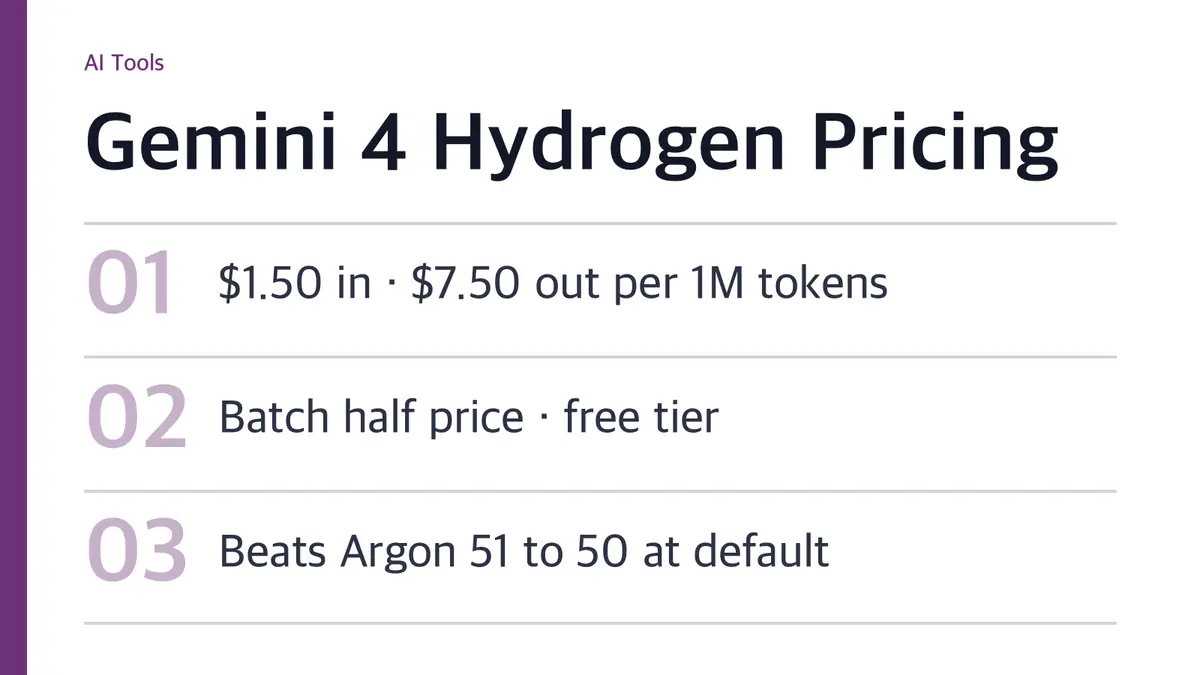
| Standard (paid) | $1.50 | $7.50 | $0.075 | No |
| Batch / Flex | $0.75 | $3.75 | $0.0375 | No |
| Priority | $2.70 | $13.50 | $0.135 | No |
A few billing details matter more than the headline rate:
- No long-context surcharge. Google prices Hydrogen flat across its entire 1M-token window, so a prompt that fills most of the window costs the same per token as a short one.
- Thinking tokens are billed as output. Every token the model reasons with counts at the $7.50 output rate, along with internal tool instructions and function declarations when you use grounding.
- Caching is automatic only. Hydrogen does not support explicit caching (`cachedContents`). Implicit caching kicks in on prompts of at least 4,096 tokens and cuts cached input by 95%, to $0.075.
- Search grounding is extra. Paid accounts get 5,000 free Google Search grounding requests a month, shared across Gemini 3 and newer models, then $14 per 1,000, capped at 1,500 requests a day. The free tier can't use grounding at all.
Hydrogen vs. 3.8 Flash, Argon and Carbon prices
Hydrogen launched into a lineup where two price changes are already scheduled. Here is the standard paid rate for each model, now and after the announced changes.
| Model | Price now (input / output) | Scheduled change |
|---|---|---|
| Gemini 4 Hydrogen | $1.50 / $7.50 | None announced |
| Gemini 3.8 Flash | $0.75 / $3.75 | $1.50 / $7.50 from January 1, 2027 |
| Gemini 4 Argon | $2.00 / $10.00 | $4.00 / $20.00 from December 1, 2026 |
| Gemini 4 Carbon | $2.00 / $10.00 | $4.00 / $20.00 from December 1, 2026 |
| Gemini 3.5 Flash-Lite | $0.30 / $2.50 | None announced |
Two things stand out. 3.8 Flash is half Hydrogen's price only until the end of 2026; from January 1 the two cost exactly the same. And Argon and Carbon have no free tier, while Hydrogen does.
What one job costs at each date
Take a single job that sends 1 million input tokens and gets back 200,000 output tokens, thinking included, at standard rates:
| Model | November 2026 | December 2026 | January 2027 |
|---|---|---|---|
| Hydrogen | $3.00 | $3.00 | $3.00 |
| Hydrogen (Batch) | $1.50 | $1.50 | $1.50 |
| 3.8 Flash | $1.50 | $1.50 | $3.00 |
| Argon or Carbon | $4.00 | $8.00 | $8.00 |
| 3.5 Flash-Lite | $0.80 | $0.80 | $0.80 |
If you are on 3.8 Flash today, staying put saves money for about six more weeks.
After that, Hydrogen is the same price and, by Google's own testing, finishes tasks 2.5 times faster at its default setting and scores 57% on Terminal-Bench 4.1 versus 18.2% for 3.8 Flash. Google lists Hydrogen as the recommended upgrade from 3.8 Flash and older Gemini 3 and 2.5 models.
Thinking levels change your bill more than the price list
Hydrogen has four thinking levels: low, medium, high (the default) and xhigh. Because thinking tokens bill at the output rate, the level you pick decides how much you really pay. Artificial Analysis, the independent benchmark site Google cites, ran its Intelligence Index at every level:
| Thinking level | Intelligence Index score | Output tokens used on the test | Time per task |
|---|---|---|---|
| low | 27 | 20.3M | 1.4 min |
| medium | 41 | 54.4M | 3.8 min |
| high (default) | 51 | 110M | 8.3 min |
| xhigh | 54 | 304M | 14.7 min |
Going from high to xhigh buys 3 points but produces almost three times the output tokens, which means almost three times the output bill. Artificial Analysis puts the xhigh run at $3.16 per task. Google says the same thing in plainer words: xhigh increases latency and token use and can overthink simple prompts.
A practical way to set it:
- Start at high, the default. It is the setting where Hydrogen edges out Argon, 51 to 50.
- Try medium on your own test prompts. It used about half the output tokens of high on the index.
- Use low for chat, routing and bulk processing where speed matters most.
- Keep xhigh for hard, multi-step coding or agent tasks where high falls short.
The Artificial Analysis figures are as of November 15, 2026, and the site updates them as it reruns tests.
Is Hydrogen better than Argon for the money?
At the default setting, yes on the headline index: Hydrogen scores 51 to Argon's 50 while charging $1.50 / $7.50 against Argon's $2.00 / $10.00, which doubles on December 1.
Google still positions Argon and Carbon for deep, long-horizon reasoning, and its own advice is to pair them: let Carbon plan or untangle hard problems, then hand code edits, subagent tasks and test runs to Hydrogen.
Against rivals, Google's model card compares Hydrogen with Claude Sonnet 5.5 and GPT-6.1 Terra. Hydrogen leads on 7 of the 10 benchmarks, including SWE-sweep (13.5% vs. 3.1% for Sonnet 5.5) and Agents' Last Exam v1.1 (71.6% vs. 60.4%). Sonnet 5.5 wins on three:
| Benchmark | Hydrogen | Claude Sonnet 5.5 | GPT-6.1 Terra |
|---|---|---|---|
| Terminal-Bench 4.1 | 57.0% | 63.9% | not listed |
| OSWorld-2.1 (computer use) | 77.6% | 83.9% | 74.2% |
| Terminal-Bench-Science 0.1 | 51.4% | 59.9% | 58.3% |
If your agent mostly drives a terminal or a desktop, weigh those three rows before switching. These are Google's numbers, not an independent test.
Free tier: what you give up
You can call `gemini-4-hydrogen` on the free tier of the Gemini API and in Google AI Studio for free. Three trade-offs come with it:
- Your prompts and responses can be used to improve Google's products. On paid tiers they are not.
- Search and Maps grounding are not available.
- Batch and Flex are paid-only.
For personal projects and prototypes, that is a good deal. For customer data or company documents, move to the paid tier.
Moving from 3.8 Flash: changes that affect cost
Swapping the model ID from `gemini-3.8-flash` to `gemini-4-hydrogen` works, but a few defaults change:
- Default thinking is higher. Hydrogen defaults to high, not medium, so the same prompt can use more output tokens. Test medium if your costs jump. Sending `minimal` now returns an error.
- One shared 1M window. 3.8 Flash had separate 1M input and 64K output budgets. Hydrogen shares 1,048,576 tokens across input, thinking and output.
- 64K per synchronous response. Responses top out at 65,536 tokens per request. For longer output, set `max_output_tokens` higher and `background` to true, up to 1,048,576 minus your input.
- Explicit caches go away. Remove `cached_content` fields and rely on implicit caching.
- Sampling settings are ignored. Remove `temperature`, `top_p` and `top_k`; out-of-range values return a 400 error.
Moving from Argon or Carbon needs no request changes.
Using Hydrogen without the API
If you just want Hydrogen in the Gemini app, you pay for a Google AI plan, not per token. US prices and what each plan gets:
| Plan (US) | Price | Chat models | Task models |
|---|---|---|---|
| Free | $0 | Auto or Flash-Lite | None |
| Google AI Plus | $4.99/month | Flash-Lite, Hydrogen | None |
| Google AI Pro | $19.99/month | Flash-Lite, Hydrogen, Pro, Argon | Hydrogen, Argon |
| Google AI Ultra | $99.99 or $199.99/month | Flash-Lite, Hydrogen, Argon, Carbon | Hydrogen, Argon, Carbon |
Free users can't pick Hydrogen from the menu. With auto model selection on, most prompts go to Flash-Lite, and only prompts that need more reasoning may use Hydrogen. With auto off, every answer comes from Flash-Lite. AI Plus at $4.99 is the cheapest way to choose Hydrogen directly. The app offers Low, Medium and High thinking levels; xhigh is API-only.
Hydrogen also powers Google Search for all users globally at no charge.
In Google Antigravity, Google's coding agent app, it is rolling out to paid subscribers, along with Orchestrator, which switches between Hydrogen and Argon or Carbon inside one task. Google says Orchestrator came close to Carbon's success rate on Terminal-Bench 4.0 while using 24% less quota on average.
Sources
- Introducing Gemini 4 Hydrogen (Google blog)
- Gemini Developer API pricing
- What's new in Gemini 4 Hydrogen (Gemini API docs)
- Gemini 4 Hydrogen model card (Google DeepMind)
- About Gemini models (Gemini Apps Help)
- Google AI plans (US)
- Gemini 4 Hydrogen and Orchestrator (Google Antigravity blog)
- Gemini 4 Hydrogen on Artificial Analysis
Prices are Google's US list prices as of November 15, 2026, and Google can change them. Benchmark results are from Google and Artificial Analysis as published on that date.
Related guides
 Claude Code Pricing: Not on Free, $20 Pro, $100 Max, $200 UltraClaude Code is included in every paid Claude plan but not in Free. Here is what Pro, Max and Ultra cost, how their…
 ChatGPT Pro Price: $100, $200 or $500 a Month, With API CreditsOpenAI now sells three Pro tiers. Here is what each costs, what changes between them, and how the new monthly API…
 Perplexity Pro Price: $20 a Month, Max $200, Students $10Perplexity Pro is $20 a month, Max is $200 a month, and verified students pay $10. The real difference is search…