Last updated: November 16, 2026
How much has DDR4 gone up? The price history
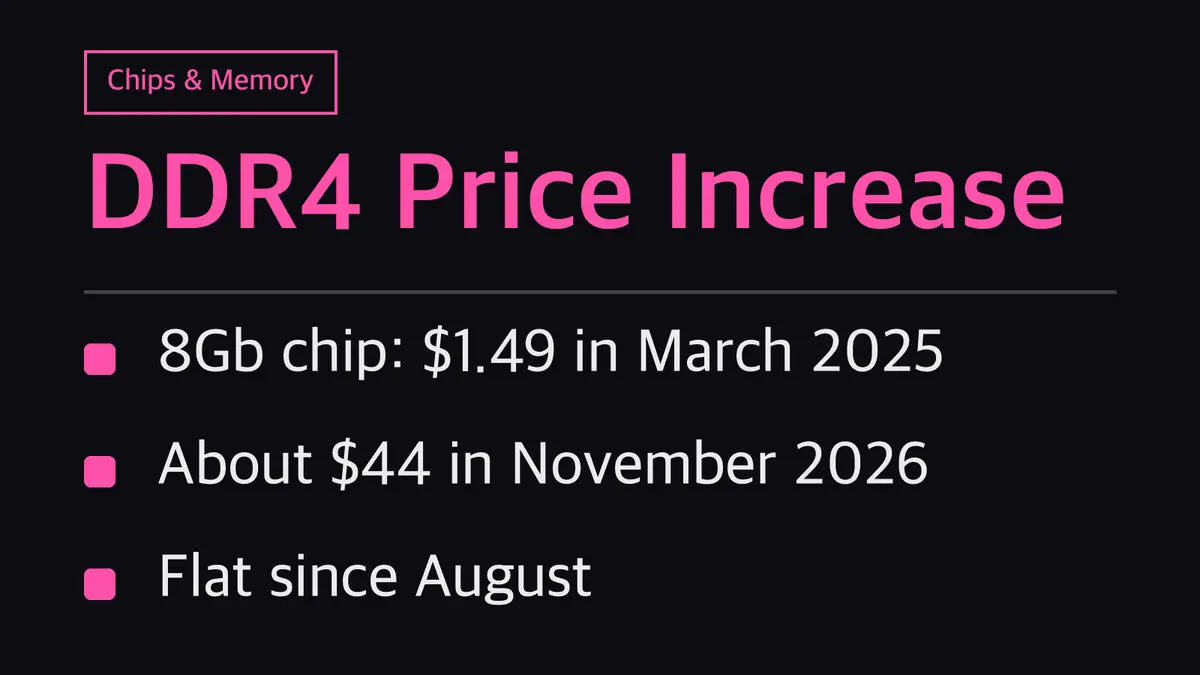
TrendForce, a Taiwan-based market research firm, publishes a weekly average spot price for the DDR4 chip the industry treats as the benchmark: DDR4 1Gx8 3200MT/s, an 8-gigabit chip. These are the figures from its weekly reports.
| TrendForce report | DDR4 8Gb chip, average spot price | Change vs. March 2025 |
|---|---|---|
| March 19, 2025 | $1.486 | — |
| June 11, 2025 | $3.314 | about 2.2x |
| October 22, 2025 | $7.931 | about 5.3x |
| December 31, 2025 (Dec. 30 trading) | $23.746 | about 16x |
| March 25, 2026 (Mar. 24 trading) | $34.00 | about 23x |
| August 12, 2026 (Aug. 10 trading) | $42.50 | about 29x |
| November 4, 2026 (Nov. 3 trading) | $46.82 | about 32x |
| November 16, 2026 (price page) | $44.357 | about 30x |
Two things stand out:
- The steepest climb came at the end of 2025. The chip tripled between late October and the end of December 2025.
- The rise has stalled. From August to November 2026 the price moved only a few dollars. In its November 4 report, TrendForce said DDR4 spot prices were sitting above suppliers' official quotes while end demand stayed weak, so buyers expected a correction and held off. Trading volume shrank, and the average dipped 0.09% that week.
The spot market is where traders and smaller buyers pick up chips outside long-term contracts. It reacts faster than the contract prices big PC makers pay, which is why it is a good early signal of direction.
What a DDR4 stick costs wholesale right now
Chip prices are not stick prices, so here is what TrendForce lists for finished modules.
| Item (TrendForce) | Price | Date |
|---|---|---|
| DDR4 UDIMM 16GB 3200 desktop stick, spot | $164.16 average (weekly range $156 to $185) | Nov. 9, 2026 update |
| DDR5 UDIMM 16GB 4800/5600 desktop stick, spot | $245 average | Nov. 9, 2026 update |
| DDR4 16GB SO-DIMM laptop stick, contract | $275 average, up 1.85% | Second half of September 2026 |
These are wholesale figures, before retailer margins and sales tax, so the price you see at a store will be higher. They still show the pattern: a 16GB DDR4 desktop stick trades about $80 below a 16GB DDR5 stick.
At the chip level, the order flips. On November 16, a 16Gb DDR4 chip (3200) averaged $79.375 on the spot market, while a 16Gb DDR5 chip averaged $60.333. Old memory costing more than new memory per chip is the clearest sign of how short DDR4 supply has become.
Why DDR4 got so expensive
DDR4 did not get more useful. Fewer factories are making it while plenty of equipment still needs it.
Samsung, SK hynix and Micron are leaving DDR4
The three largest memory makers have all been pulling back:
- Samsung stuck to its DDR4 end-of-life (EOL) plan. In its December 31, 2025 report, TrendForce said Samsung "clearly stated it will not defer its EOL plan," so DDR4 supply would fall quickly in 2026.
- SK hynix also signaled it would phase out DDR4 by 2026. TrendForce, citing Korean business daily Maeil Business Newspaper, says Samsung and SK hynix made short-term adjustments when DDR4 prices rebounded in 2025, with SK hynix temporarily raising output at its Wuxi, China plant. Korean tech daily ETnews then reported in January 2026 that SK hynix had moved the Wuxi fab from its 1z process to the newer 1a node, with about 90% of capacity on 1a. That means those lines are making newer memory, not DDR4.
- Micron announced on December 3, 2025 that it would exit the Crucial consumer business, keeping shipments to retailers going only until the end of its fiscal Q2 (February 2026). Micron said AI-driven data center growth had caused a surge in demand and that it wanted to improve supply for larger, strategic customers.
Servers and AI took the capacity
Every memory maker is putting its best production lines into server DRAM and HBM, the stacked memory used next to AI chips. TrendForce's January 2026 coverage says suppliers would keep sending advanced nodes and new capacity to server and HBM products, tightening supply everywhere else.
Buyers who still need DDR4 kept buying
DDR4 is still in a huge number of desktops, servers, network gear and industrial machines. When supply tightened, enterprise buyers bought more aggressively. In January 2026, TrendForce reported that DDR4 prices jumped by up to 50% in Q1 2026 as those buyers stocked up. By March, prices for 4Gb DDR4 chips rose more than 20% in a single month, and demand had started spilling into even older DDR3 and DDR2 parts.
Taiwanese makers shifted capacity toward DDR4 to catch that demand, but TrendForce says capacity limits kept supply tight, and the overflow pushed prices up in older chips too.
Will DDR4 prices go down?
Not by much, and not soon. The spot market has stopped climbing, but the forces behind the increase are still in place.
| Signal | What TrendForce reported |
|---|---|
| Spot prices | Flat to slightly down since August 2026; $46.82 on Nov. 3, $44.36 on Nov. 16 |
| Contract market | Suppliers keep phasing out DDR4, so consumer DRAM contract prices are rising moderately this quarter (Oct. 28, 2026 bulletin) |
| PC DRAM contracts | Forecast to rise 13% to 18% quarter over quarter in Q4 2026, slower than Q3 (Nov. 11, 2026) |
| 2027 supply | Memory makers tentatively plan to cut PC DRAM supply in 2027 because AI demand is strong (Nov. 11, 2026) |
| Demand | Notebook shipments fell 15.8% quarter over quarter in Q3 2026, and PC makers are sitting on more inventory (Nov. 11, 2026) |
The weak PC demand is the one force pushing the other way, and it is why the spot price has softened. But with Samsung and SK hynix not adding DDR4 lines and suppliers planning less PC memory for 2027, a return to 2025 prices is not on the table. A small correction from today's level is the realistic best case.
Should you buy DDR4 now or wait?
It depends on what you are doing.
- You need to fix or finish a DDR4 PC now: buy what you need. Prices have stopped rising, so there is no reason to panic-buy extra, and waiting a few months is unlikely to save much.
- You want to max out an old DDR4 system: weigh the cost against a new platform. Per stick, 16GB of DDR4 is still about $80 cheaper wholesale than 16GB of DDR5, but a full upgrade to an aging board may not be worth it.
- You are building a new PC: DDR4 is not a bargain anymore. A current DDR5 platform gives you a longer upgrade path, even though DDR5 is expensive too.
- You are selling an old PC or spare sticks: DDR4 now holds value it never used to. Unused modules from a drawer are worth listing.
DDR4 and DDR5 sticks are not interchangeable. A DDR4 motherboard only takes DDR4, so check your board before you buy.
Sources
- TrendForce: Mainstream DDR4 prices dip 0.09% (Nov. 4, 2026)
- TrendForce DRAM price trends (spot, contract and module prices)
- TrendForce: PC OEMs adjust memory procurement plans for 2027 (Nov. 11, 2026)
- TrendForce DRAM Market Bulletin, Oct. 28, 2026
- TrendForce: DDR4 spot prices climb as Samsung holds EOL line (Dec. 31, 2025)
- TrendForce: Memory giants map their 2025-26 exit strategy (Jan. 19, 2026)
- TrendForce: DDR4 leads legacy memory rally with Q1 prices up to 50% (Jan. 19, 2026)
- TrendForce: March consumer DRAM price surge led by sub-4Gb products (Apr. 7, 2026)
- Micron: Micron announces exit from Crucial consumer business (Dec. 3, 2025)
Related guides
 Will RAM Prices Go Down? Not in 2027, Memory Makers SignalRAM prices are still rising in late 2026, only more slowly. Supply for PCs is set to shrink in 2027 as chipmakers…
 DDR5 Price Now: 16GB Sticks Near $242 Wholesale, Still RisingDDR5 is still getting more expensive. Here are the latest wholesale numbers from TrendForce, why memory makers keep…
 SSD Prices Going Up? NAND Contract Prices Rise 15–20% in Q4 2026NAND flash, the chips inside every SSD, has risen every quarter of 2026. Here is how much, why, and what it means if…