Last updated: November 17, 2026
Carbon vs Argon at a glance
Google released Argon first, in mid-October. It announced Carbon on October 28, 2026, gave it to a group of cybersecurity defenders through its Fairwind Program, and opened it to all paying developers, businesses and Google AI Ultra subscribers on November 10.
| Gemini 4 Carbon | Gemini 4 Argon | |
|---|---|---|
| Google's description | Strongest model, for the hardest long-horizon problems | Efficient frontier model, faster with lower token spend per turn |
| API model code | `gemini-4-carbon` | `gemini-4-argon` |
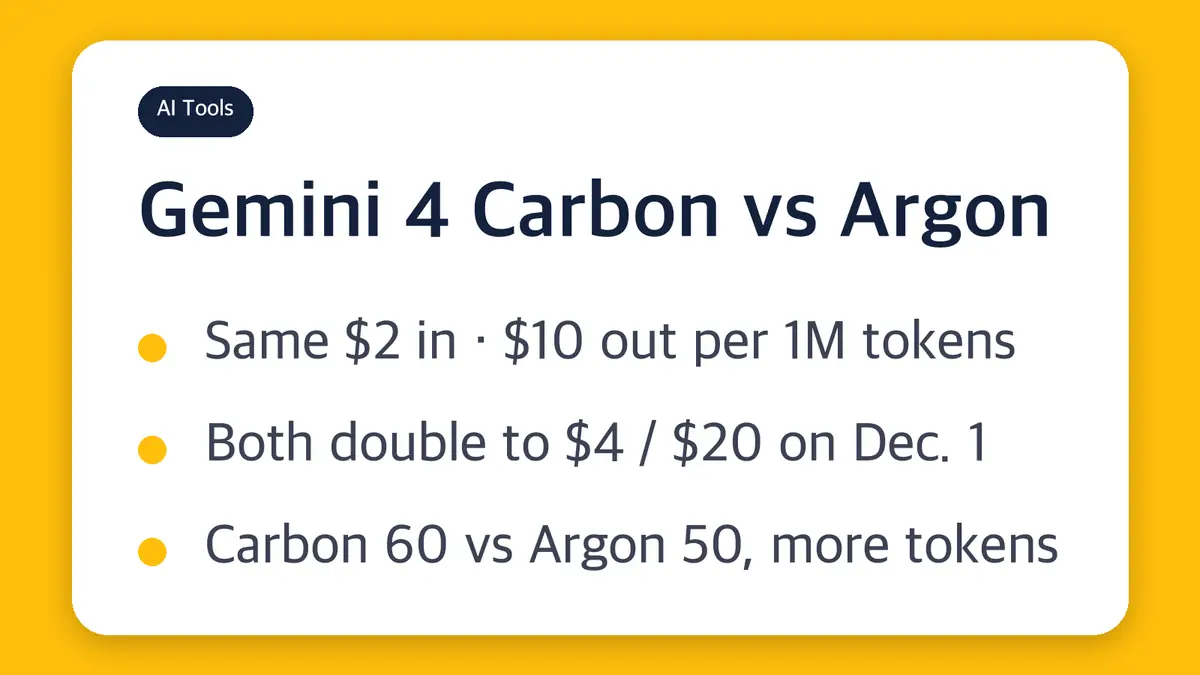
| Price now (input / output per 1M) | $2 / $10 | $2 / $10 |
| Price from December 1, 2026 | $4 / $20 | $4 / $20 |
| Free API tier | No | No |
| Context window | 1M tokens | 1M tokens |
| Max output | 64K / 1M tokens | 64K / 1M tokens |
| Inputs | Text, image, audio, video, PDF | Text, image, audio, video, PDF |
| Artificial Analysis Intelligence Index | 60 (high) | 50 (high) |
| Gemini app plan needed | Google AI Ultra | Google AI Pro or Ultra |
The spec rows are identical. What separates the two models is how hard they think, what that costs you in tokens, and which subscription unlocks them in Google's apps.
The price is the same, and so is the December 1 increase
Google's pricing page lists Carbon and Argon with the same rates on every tier, and every rate doubles on the same day.
| Rate per 1M tokens | Now (until Nov. 30) | Starting Dec. 1 |
|---|---|---|
| Standard input | $2.00 | $4.00 |
| Standard output (thinking included) | $10.00 | $20.00 |
| Cached input | $0.10 | $0.20 |
| Batch or Flex input | $1.00 | $2.00 |
| Batch or Flex output | $5.00 | $10.00 |
| Priority input | $3.60 | $7.20 |
| Priority output | $18.00 | $36.00 |
A few billing rules apply to both models:
- No free tier. Neither model runs on the free tier of the Gemini API.
- Thinking counts as output. Every token the model reasons with is billed at the output rate, along with internal tool instructions and function declarations when you use grounding.
- Implicit caching only. Explicit caching is not supported, and cached input is billed at 95% off the input price.
- Search grounding is extra. Paid accounts get 5,000 free Google Search requests a month, shared across Gemini 3 and newer models, then $14 per 1,000, capped at 1,500 a day.
What one job costs before and after December 1
Take a single job that sends 1 million input tokens and gets back 200,000 output tokens, thinking included, at standard rates:
| Model | November 2026 | December 2026 |
|---|---|---|
| Carbon or Argon, standard | $4.00 | $8.00 |
| Carbon or Argon, batch | $2.00 | $4.00 |
If you have large jobs that can wait, run them before November 30 or move them to Batch, which after the increase costs what Standard costs today.
Same price per token is not the same bill
Google says plainly that Carbon uses more tokens than Argon to explore, reason and run verification loops, while Argon gives faster responses with lower token spend per turn. Artificial Analysis measured how big that gap is when both run its full Intelligence Index at the same $2 / $10 rates:
| Model and effort | Index score | Output tokens on the test | Cost per task | Time per task |
|---|---|---|---|---|
| Carbon (high) | 60 | 205M | $5.48 | 31.1 min |
| Carbon (medium) | 58 | 124M | not listed | 30.2 min |
| Carbon (low) | 54 | 83.9M | not listed | 28.5 min |
| Argon (high) | 50 | 113M | $4.97 | 29.3 min |
| Argon (medium) | 48 | 81.7M | not listed | 28.6 min |
Three things stand out:
- Carbon at high produced almost twice Argon's output tokens (205M vs 113M), yet its average cost per task was only about 10% higher, $5.48 vs $4.97.
- Carbon at low effort still outscores Argon at high, 54 to 50, while producing fewer output tokens (83.9M vs 113M). If you want Carbon's quality without its token appetite, test the lower effort setting first.
- Neither is fast. Both take close to half an hour per index task, well above the 13.3-minute median Artificial Analysis lists for models in their price range.
These are averages over one benchmark suite, not your workload. After December 1, every number in the cost column doubles along with the rates.
Where Carbon beats Argon, and where it doesn't
Carbon's lead is widest on long, multi-step work. Google built it for complex coding and debugging, open-ended scientific research and cybersecurity, and Google's own comparisons with Argon point the same way:
- Honesty: On Google's 375-task agentic honesty benchmark, Carbon passed 92% of tasks vs 70% for Argon, and Google says it cuts unsupported claims by about 2x over Argon.
- Secure code: More than 2x higher success rate than Argon at generating secure code, on Google's internal tests.
- Prompt injection: 0.0% attack success on Gray Swan's indirect prompt injection benchmark, vs 0.7% for Argon.
- Misuse safeguards: In simulated cyberattack testing, the per-attempt breach rate fell to 0.8%, down from 3.1% on Argon.
Those are Google's numbers. Zapier's AutomationBench, an outside test of agents doing real business tasks in CRMs, inboxes and calendars, shows a smaller gap:
| AutomationBench (v1.0.6) | Score |
|---|---|
| Carbon (high) | 53.88% |
| Carbon (medium) | 52.97% |
| Argon (high) | 51.29% |
| Argon (medium) | 50.08% |
By business area, Argon still takes first place in Sales (58.12%, Argon medium, ahead of Carbon high at 56.41%) and HR (39.17%), and ties Carbon in Operations at 68.00%. For everyday automation, the two models are close.
Which one should you use?
Use Argon for most coding and knowledge work. Google itself calls Argon the right pick for the majority of software engineering and knowledge tasks, and it answers faster with fewer tokens per turn.
Use Carbon when Argon falls short:
- Bugs that span many files or subsystems, multi-package migrations and architecture redesigns
- Long agent runs that need to verify their own work
- Security review, vulnerability triage and patching
- Research and analysis where a wrong or invented figure is costly
Because the API price is identical, switching costs nothing extra per token. A practical setup is to run Argon by default and send only the jobs it fails to Carbon. In Google Antigravity, Google's agent coding app, the new /swarm preview lets you put Carbon in planning and review roles while lighter, faster models handle the parallel work.
If cost is the main concern, also look at Gemini 4 Hydrogen. At $1.50 / $7.50 with no December increase announced, it edges out Argon on the Artificial Analysis index at its default setting, 51 to 50.
Using Carbon or Argon in the Gemini app
In the Gemini app you pay a monthly plan, not per token. Here is what each US plan includes:
| Plan (US) | Price | Argon | Carbon |
|---|---|---|---|
| Free | $0 | No | No |
| Google AI Plus | $4.99/month | No | No |
| Google AI Pro | $19.99/month | Yes | No |
| Google AI Ultra | $99.99 or $199.99/month | Yes, highest access | Yes, highest access |
The $99.99 Ultra plan has 5x Pro's usage limits and the $199.99 plan has 20x. Ultra subscribers also get Carbon in Google Antigravity and in AI Mode in Google Search, which offers Carbon only in select countries.
So for one person who just wants to chat, Argon on AI Pro costs $80 a month less than Carbon on the cheapest Ultra plan. Two other routes exist: scientists can apply for six months of free Argon and Carbon access through Antigravity's top usage tier, and security teams can apply to the Fairwind Program for Carbon for cyber.
Sources
- Gemini 4 Carbon is now available (Google blog, Nov. 10, 2026)
- Introducing Gemini 4 Carbon (Google blog, Oct. 28, 2026)
- Gemini Developer API pricing
- Gemini models (Gemini API docs)
- About Gemini models (Gemini Apps Help)
- Google AI plans (US)
- Gemini 4 Carbon (Artificial Analysis)
- Gemini 4 Argon (Artificial Analysis)
- AutomationBench leaderboard (Zapier)
Related guides
 Gemini 4 Hydrogen Pricing: $1.50 Input, $7.50 Output per 1M TokensGemini 4 Hydrogen's API price is $1.50 in and $7.50 out per million tokens with no long-context surcharge. Here is…
 Claude Code Pricing: Not on Free, $20 Pro, $100 Max, $200 UltraClaude Code is included in every paid Claude plan but not in Free. Here is what Pro, Max and Ultra cost, how their…
 ChatGPT Pro Price: $100, $200 or $500 a Month, With API CreditsOpenAI now sells three Pro tiers. Here is what each costs, what changes between them, and how the new monthly API…